
How to write for your school website that wins more admissions
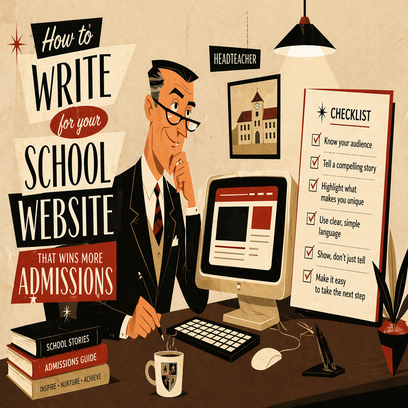

Most school websites are written for the wrong person. They are written for governors. For inspectors. For the school itself. Not for the parent sitting at the kitchen table at 10pm, quietly weighing up whether your school is right for their child.
That parent is intelligent, time-pressed and slightly anxious. They want to feel understood, not sold to. And most school websites fail them. Here is a practical guide to writing school website copy that actually works for admissions.
What does good school website copy look like?
It names real things. Specific things. Things that only your school could say. The test is simple: if you swapped your school’s name for a competitor’s and the sentence still made sense, cut it and start again.
A prep school in Surrey rewrote their About Us page with exactly this principle in mind.
Before: “Our ethos of excellence permeates every aspect of school life, from our outstanding academic provision to our breadth of co-curricular opportunity.”
After: “We are a small school on purpose. Every teacher knows every child. Your son will not get lost here.”
Enquiries from that page increased by 34% the following term.
The second version works because it makes a specific promise that a parent can hold you to. That is what trust is built on.
What words should schools avoid on their website?
Drop these immediately: world-class, holistic, transformative, nurturing environment, ethos of excellence, breadth of opportunity, passionate staff.
Parents skip straight past them. They have read these phrases on every school website they have visited this week. The problem is not just that they are clichés. The problem is that they are unverifiable. A parent cannot know if your staff are passionate. They can know that Mrs Hargreaves has run the same science club for 14 years.
“Nurturing environment” could describe any school in the country. “When one of our Year 3 pupils was nervous about starting, her teacher wrote her a letter over the summer holidays” could only describe yours.
Every generic phrase on your website is a missed opportunity to say something true and specific. Go through your copy and ask: what is the real story behind this claim? Then tell that story instead.
How should admissions pages be written?
Every page on your website should do one of three things: build trust with the parent reading it, answer a question they actually have, or move them towards the next step.
Lead with outcomes, not process. Look at the difference between these two sentences.
Process-led: “Our structured assessment framework tracks pupil progress across all key stages.”
Outcome-led: “Children leave us confident, well-rounded and ready for whatever comes next.”
The first sentence makes a parent feel something. The second makes their eyes glaze over. Your admissions team already knows what your assessment framework does. The parent does not need to.
What calls to action should a school website have?
Most schools know they need a “Book a Visit” button. The part that is often missed is the difference between a CTA that converts and one that just sits there.
Generic: “Contact us to find out more about our open mornings.”
Specific: “Join us on Saturday 18 October at 10am. Coffee, a tour, and a chance to meet the Head.”
The specific version works for three reasons. It removes uncertainty about what will happen. It sets a date, which creates a natural decision point. And “meet the Head” signals accessibility rather than formality. A parent reading it at 10pm knows exactly what they are signing up for.
Apply the same logic to every conversion point: Book a Visit, Request a Prospectus, and Contact Us. Each one should tell the parent what happens next, not just invite them to get in touch.
How do you write copy that gets found on Google and AI search?
Parents are no longer just Googling. They are asking ChatGPT, Claude and Perplexity questions like “What are the best prep schools in West Sussex?” and AI is answering with a confident shortlist. If your school is not on it, you do not exist in this new discovery channel.
Writing for AI discoverability means writing in the language parents actually use, not the language schools use internally. Structure content around the questions prospective families are already asking. Use plain, descriptive subheadings. Answer admissions questions step by step, completely, on the page. Do not make parents request a prospectus to find out your fees.
The schools winning in AI search right now are the ones writing for parents first and algorithms second. The good news is those two things are the same thing.
If your copy is clear, specific and structured around real questions, it will perform well in both traditional search and AI-generated answers. The schools that disappear from AI shortlists are almost always the ones with the most jargon-heavy, inspector-facing copy.
Where should a school start?
Pick one page. Not your homepage, which is too politically charged to rewrite quickly. Pick your About Us page, or your admissions overview. Read every sentence and ask: does this tell a parent something true and specific about our school, or does it tell them something they could have read anywhere?
Cut everything in the second category. Replace it with a real story, a specific fact, or a concrete promise. Publish it. Then look at what happens to your enquiry rate from that page over the following half term.
Most schools that do this do not go back. The evidence makes the argument for them.
Want to see how Innermedia helps schools discover online success? We run a free live session every week on Zoom showing how our aiSolutions, Digital Experience Platform and imHUB CRM turn digital engagement into measurable admissions results. Join us. innermedia.co.uk