

Google’s New Ad Positioning Metrics

In November of this year, Google released four new search ad position metrics. They’re being rolled out to account any time now so don’t worry if they’re not available in yours yet, they will be soon.
Here we will discuss and explain the new metrics and how you can adjust the way you are measuring ad positioning. We’ll start with the new metric definitions, which are shown on Google’s Support Page – https://support.google.com/google-ads/answer/9140484
- Impressions (Absolute Top) % – The percent of your advert impressions that are shows as the very first advert above the organic search results
- Impressions (Top) % – The percent of your advert impressions that are shown anywhere above the organic search results
- Search (Absolute Top) Impression Share – The impressions you have received in the absolute top location (the very first advert above the organic search results) divided by the estimated number of impressions you were eligible to receive in the top location.
- Search (Top) Impression Share – The impressions you’ve received in the top location (anywhere above the organic search results) compared to the estimated number of impressions you were eligible to receive in the top location.
There is a difference between Absolute Top and Top. Absolute Top refers to the very first advert on the results page whereas Top includes every advert that is above the organic results. The definition of Google’s Average Ad Position often gets overlooked by advertisers and agencies. The current definition is “a statistic that describes how your ad typically ranks against other ads. This rank determines in which order ads appear on the page.”
An average position of between 1 and 8 is generally on the first page of the search results, and between 9 and 16 will be page 2 and so on. So, if your average position is 1.7, then your advert usually appears in position 1 or 2.
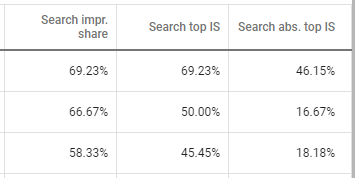
If we look at the example above, we have Ad Positioning metrics for three different campaigns in one account. Let’s take the middle row, and our advert has been shown 66.67% of the time it has been eligible to show. 50% of the time it has been shown “Top” which, as seen above, isn’t necessarily the number one position, but it does mean that it has been above all of the organic results in half the searches it has appeared in.
Out of all searches we have been eligible to show in, 16.67% of those have appeared in Absolute Top position which means it is the highest showing advert. But even this doesn’t guarantee we have been top of the page. Google states “Sometimes no ads are displayed above the organic search results so the ad with a position of 1 appears at the bottom of the page.” This just means, that Absolute Top is the highest showing advert on the page.
Notice we haven’t shown you the Average Position for these campaigns because that only explains part of the picture. If we’re just using the Average Position, we aren’t optimising with the most effective strategy. Going forwards, we should be considering the four metrics listed at the top to get a fuller picture of how we are showing, where we are showing and when we are showing against how often we could be.