
Why You Need Both SEO and AEO in 2026

Here is a question worth asking yourself: is your brand visible in AI-generated answers? Not just ranking on Google – but actually being cited when someone asks ChatGPT, Gemini, or Claude a question in your space?
If you are not sure, or if you have assumed that your SEO work covers it, this article is for you. Because the two disciplines are related – but they are not the same, and treating them as interchangeable is one of the most common mistakes we see brands making right now.
They Are Fundamentally Different Disciplines
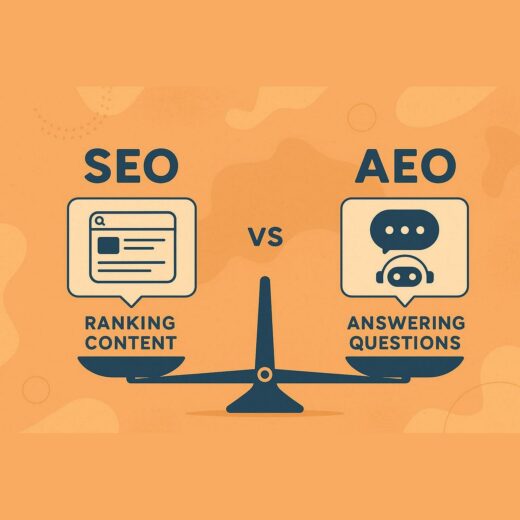
Search Engine Optimisation (SEO) and Answer Engine Optimisation (AEO) share some common ground, but they have different goals, different signals, and different definitions of success.
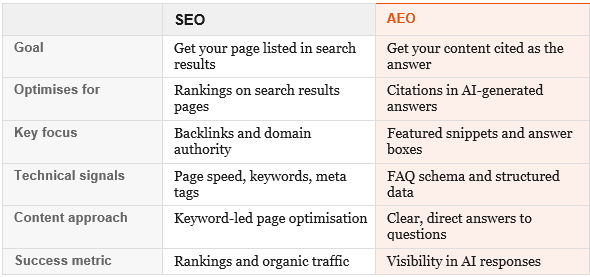
SEO is built around rankings. Its aim is to get your pages listed prominently in search engine results pages, driven by backlinks, domain authority, keywords, meta tags, and technical performance. If your SEO is working, people find your site when they search.
AEO is built around citations. Its aim is to get your content selected as the answer when an AI platform responds to a query. It depends on structured data, FAQ schema, clear and direct writing, and the kind of authoritative third-party presence that signals credibility to an AI. If your AEO is working, AI platforms cite you when people ask questions.
The distinction matters because the two can diverge completely in practice:
→ You can rank number one on Google and never be cited by ChatGPT.
→ You can be regularly cited by AI platforms and still sit on page three of Google.
Different inputs. Different outputs. Different strategies.
SEO vs AEO at a Glance
Where They Overlap – and Why That Creates Confusion
The reason so many teams conflate SEO and AEO is that there is genuine common ground. Both disciplines reward the same underlying qualities in content:
- High-quality, authoritative content that demonstrates genuine expertise
- Clear topic coverage with no significant gaps
- Regular updates that keep content current and relevant
- Mobile-optimised, technically sound delivery
- A genuine focus on what the user or reader actually needs
That overlap is where teams go wrong. They see the shared foundations and conclude that a single strategy covers both. In practice, optimising for those shared qualities gets you part of the way – but not all the way. SEO and AEO each require additional, specific work on top of that common base.
The Risk of Choosing One Over the Other
Some teams, recognising the growth of AI-generated answers, pivot their entire content effort towards AEO. Others, more comfortable with established practice, stay firmly in SEO territory and assume AI visibility will follow. Both approaches leave meaningful opportunity on the table.
The reality is that your customers are not using one channel or the other – they are using both, often within the same session. They might start with a conversational AI query, follow up with a Google search, and make a decision based on what they find across both. If you are present in only one of those touchpoints, you are absent from the others.
There is also a timing argument. Traditional search is mature and competitive. AI-generated answers are still relatively new, which means the brands that invest in AEO now are building visibility in a space that is less crowded than it will eventually become. This is one of the clearer early-mover advantages we have seen in digital marketing for some time.
What a Joined-Up Strategy Looks Like
Rather than treating SEO and AEO as competing priorities, the smarter approach is to build a content strategy that addresses both deliberately. In practice, that means:
- Writing content that is both keyword-informed and structured for AI retrieval – clear headings, concise answers beneath each one, and logical coverage of related topics
- Investing in technical foundations that serve both disciplines: fast, clean pages with proper schema markup and no JavaScript-rendered content that crawlers cannot access
- Building external authority through third-party citations, not just backlinks – because AI platforms weight editorial mentions and platform presence alongside traditional link signals
- Measuring visibility across both channels, including AI referral traffic in GA4 and branded search trends as a proxy for AI-driven awareness
- Refreshing content regularly, since AI platforms notably deprioritise content older than three months, whilst fresh content also tends to perform better in traditional search
None of this requires abandoning what you already do in SEO. It requires extending it.
The Bottom Line
SEO and AEO are not rivals, and they are not the same thing. They are complementary disciplines with shared foundations and distinct execution. A brand that masters both will be visible wherever its customers are searching – whether that is a traditional results page or an AI-generated answer.
The question is not which one you should focus on. The question is whether your current strategy accounts for both.
If you are not sure where you stand, or if you would like to understand how your brand currently appears across both search and AI platforms, we would be happy to take a look.
Get in touch to find out more.