
BrightonSEO April 2026 Roundup: What the Conference Confirmed About the Future of Search

Quick summary: BrightonSEO April 2026 confirmed five major shifts in search marketing: SEO is now leading wider marketing strategy, AI is embedded across every search discipline, AI-assisted content is outperforming human-only content in AI search engines, citations have replaced backlinks as the dominant visibility signal, and traditional reporting needs rebuilding around AI visibility rather than clicks alone. For businesses, this means SEO and AI optimisation are no longer separate workstreams.
What is BrightonSEO and why does the April 2026 edition matter?
BrightonSEO is the largest dedicated search marketing conference in the world, held twice a year in Brighton, UK. The April 2026 edition took place on 30 April and 1 May at The Brighton Centre. It matters because the agenda functions as a forward indicator for the search industry: the themes that dominate Brighton typically define the next twelve months of strategy across SEO, content, AI search and digital PR.
The headline takeaway from April 2026 is that the themes the industry has been preparing for over the past eighteen months have now been formally adopted as the mainstream direction of travel. Innermedia’s view: the conference cemented the strategy we’ve already been running for our independent school clients, rather than introducing surprises.
How is SEO leading wider marketing strategy in 2026?
SEO is now leading wider marketing strategy because it sits closest to the disruption AI is causing in how people discover information. When AI assistants summarise answers, cite sources, and shape brand perception before a user ever visits a website, the discipline responsible for being findable, quotable and trusted becomes the strategic foundation for everything else.
In practice, this means:
- Content must be structured for AI summarisation, not just human readers
- Digital PR must focus on placements that AI models are likely to cite
- Social must contribute to the source material AI crawlers ingest
- Paid media must work alongside falling organic click-through rates rather than against them
Marketing teams across every sector are working hard to make sense of an environment that has shifted faster than anyone could reasonably keep up with. SEO sits closest to where those changes are landing first, which puts SEO specialists in a natural position to help guide the rest of the marketing mix.
For buninesses, this means the SEO conversation needs to happen at the start of marketing planning, not bolted on at the end.
Why is AI now central to every SEO conversation?
AI is now central to every SEO conversation because it has stopped being a single track at conferences and started running through every discipline. At BrightonSEO April 2026, AI featured in sessions on technical SEO, content, local search, reporting and paid media. There was no part of the programme where AI was absent.
The strategic question for marketers has changed. It is no longer “do we need an AI strategy?” The question is now: how do we ensure our website architecture, content, reporting and customer journey are all designed for a search environment where AI is the front door?
Is AI-assisted content outperforming human-only content?
Yes. Controlled testing presented at BrightonSEO April 2026 by Otterly showed AI-assisted content outperforming human-only content on the metrics that matter most for AI search visibility, including citations, mentions and inclusion in AI-generated answers.
This finding does not mean businesses should hand content production over to a model with no oversight. The strongest performing content follows a hybrid model:
- AI drafts and structures the content, pattern-matching against the formats LLMs prefer to cite
- Human experts add genuine experience, sector knowledge, editorial judgement and proof points
- Human editors verify facts, tone, brand alignment and accuracy before publication
The practical implication is that resisting AI in the content workflow is now actively costing visibility. Teams already running an AI-assisted content process are pulling ahead in AI search, while teams holding out for fully human content are losing ground.
How important is technical SEO in the AI search era?
Technical SEO remains the price of admission for visibility in 2026. The fundamentals have not changed:
- Crawlability: if a bot, whether Googlebot or an AI crawler, cannot access your content, you are invisible in both traditional and AI search
- Site speed: slow pages reduce visibility in LLM citations as well as Google rankings
- Clean JavaScript rendering: content that requires complex client-side rendering is often skipped by AI crawlers
- Schema markup: structured data is now critical for AI Overview visibility
- Log file analysis: essential for understanding when and how AI bots are visiting content
Speakers shared experiments showing schema markup lifting visibility in Google AI Overviews by a striking margin, while the same conditions sometimes reduced citations in ChatGPT. This nuance is why AI visibility should be treated as a layered problem, not a single optimisation.
What is the shift from rankings to visibility, and from keywords to problems?
Two of the strongest threads at BrightonSEO April 2026 were:
- The shift from rankings to visibility: measuring how often a brand is found, cited and mentioned across AI assistants, not just where it sits in a Google results page
- The shift from keywords to problem solving: analysing user problems and needs rather than chasing search volume for individual keywords
AI bots and agents now reportedly account for around 12% of website traffic, which means a single ranking position no longer represents the full picture of how findable a website is.
For independent schools, this is genuinely useful framing. Parents researching a school are not searching for one keyword. They are working through a tangle of real questions: what is the pastoral care like, how does the sixth form actually perform, what is the admissions process for an overseas family, is there flexi-boarding. These questions are asked across Google, ChatGPT, Reddit, YouTube and AI assistants that summarise everything before the parent ever reaches a school website.
Innermedia’s principle: stop optimising for the keyword, start optimising for the question and the answer.
Why are citations the new backlinks?
Citations are the new backlinks because AI models build their answers from a curated set of cited sources, and being included in that source set is the new visibility currency. The talks on where AI models actually pull their information from were some of the most actionable of the conference.
Key sources AI models prioritise:
- Reddit: a critical data source for LLMs because of the volume of authentic, conversational user-generated content
- YouTube: repeatedly named as one of the most cited platforms in AI-generated answers, with channel relevance and activity mattering more than view counts
- Authoritative editorial sites: still heavily cited, with topical authority outweighing raw domain authority
- Review platforms and forums: increasingly used as proof of real-world reputation
Is AI the new word of mouth?
Yes. AI is functioning as word of mouth on steroids. One of the neatest framings shared at the conference described the full circle of how brand discovery has evolved:
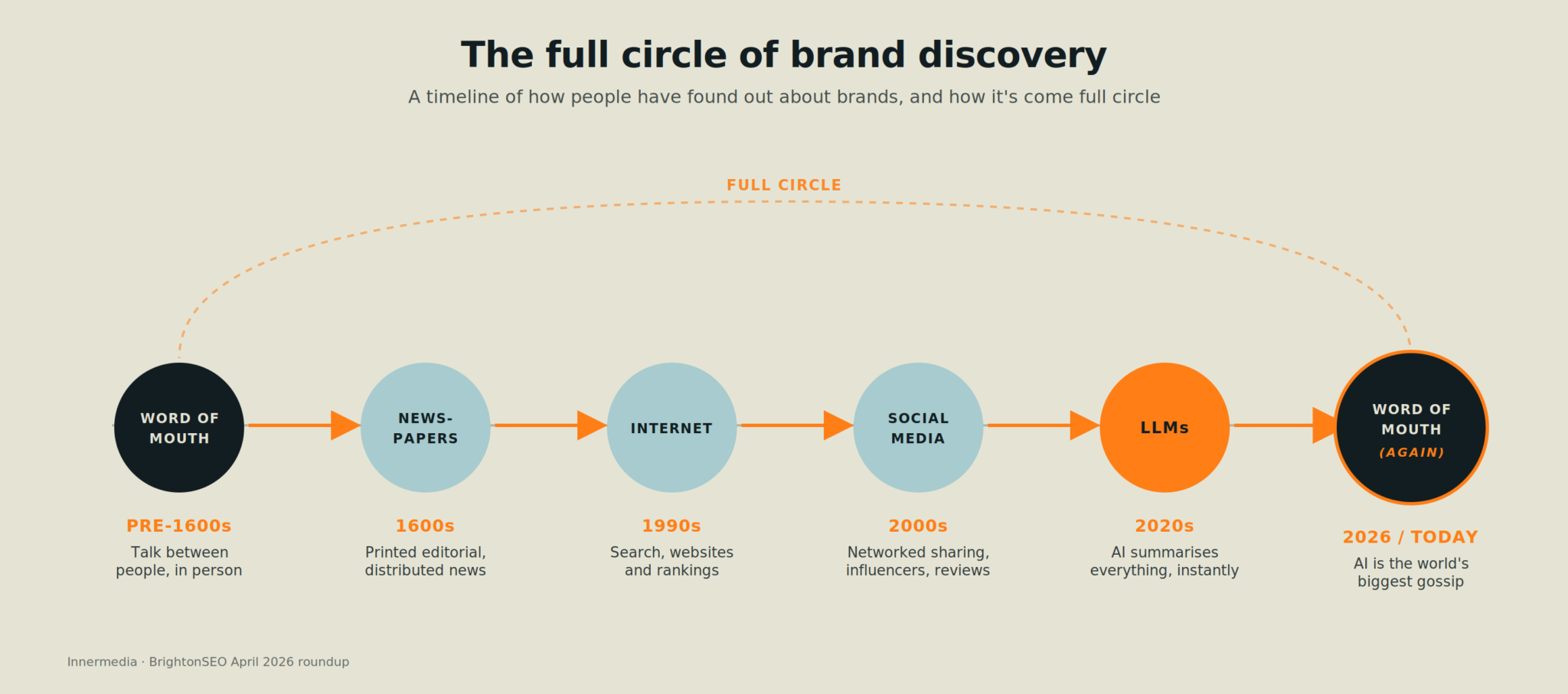
With LLMs, the loop has closed. Brand discovery has arrived back at word of mouth, only this time it is amplified, automated and instant. AI is essentially the world’s biggest gossip, pulling rumours and references from everywhere all at once: social posts, forum threads, websites, reviews, comments, transcripts, news articles. Everything goes in, gets blended, and comes back out as a single confident-sounding summary to the next person who asks.
For businesses, this changes how content distribution should be approached. A strong website is necessary but no longer sufficient. The strategic question becomes: where else does this brand need to show up so that the gossip is good? Where is it being talked about, reviewed, recommended and compared, and is there enough credible source material out there for an AI to assemble a fair picture? This is a content, PR, reputation and community question as much as it is a technical SEO one.
How should SEO reporting change in 2026?
SEO reporting needs rebuilding because click-through rates are declining as AI answers more questions in-place. Traditional traffic-based reports no longer tell the full story of SEO performance. This is part of a fundamental rethinking of how visibility works online.
Reporting in 2026 should track:
- AI visibility: how often the brand appears in AI-generated answers across ChatGPT, Google AI Overviews, Perplexity and Gemini
- Citation share: the percentage of relevant AI answers in which the brand is cited as a source
- Brand search volume: rising branded searches indicate AI exposure is driving demand
- Direct traffic: AI mentions often produce direct visits rather than referral clicks
- Lead quality and assisted conversions: the metrics that actually matter to the business
New frameworks were floated at the event, including the Revenue Influence Factor (RIF), which combines direct attribution with modelled revenue and influence on user behaviour. The underlying principle is the right one: for a school, the metrics that matter are enquiries and applications, not sessions.
What does this mean for businesses?
The implications of BrightonSEO April 2026 are clear and actionable:
- The fundamentals have not moved. Websites that are useful, trusted, technically sound and clear about what they offer will continue to be findable.
- Where you need to be findable has expanded. Visibility now needs to be earned across Google, AI assistants, Reddit, YouTube and review platforms.
- How you measure visibility needs to evolve. Rankings reports alone no longer reflect the true state of a websites discoverability.
- AI in search is not a future problem. It is the current operating environment, and the brands doing best are already adapting.
How does Innermedia’s SEO and AI SEO offer support this?
Innermedia’s core SEO service handles the foundations that BrightonSEO confirmed are still essential: technical health, on-page optimisation, content strategy, digital PR and reporting that keeps websites visible in traditional search.
Innermedia’s AI SEO bolt-on layers in everything Brighton confirmed brands now need on top of that foundation:
- AI Overviews and AI assistant optimisation, ensuring websites are eligible for citation in ChatGPT, Perplexity, Gemini and Google AI Overviews
- AI citation tracking, monitoring how often and where each business appears in AI-generated answers
- Schema and answer-shaped content, structured specifically for LLM ingestion
- Visibility monitoring across AI platforms, including the Reddit and YouTube sources AI models draw from most heavily
Together, the core SEO service and the AI SEO bolt-on form the fully rounded package independent schools need to succeed in search as it actually works in 2026, not as it worked five years ago.
Final thoughts on BrightonSEO April 2026
The biggest takeaway from BrightonSEO April 2026 is that the direction Innermedia has been taking with SEO and AI is fully aligned with where the global industry is heading. The themes the conference focused on, AI integration, citation visibility, hybrid content production, structured data, rebuilt reporting, are the themes our team has been operating against for some time.
It was reassuring to spend two days in Brighton hearing the rest of the industry arrive at the same conclusions we had already built our practice around.
If you are not sure where you stand, or if you would like to understand how your brand currently appears across both search and AI platforms, we would be happy to take a look.
Get in touch to find out more.