What the Claude “shared chats” scare teaches schools about AI and data
A weekend privacy scare shows how quickly a convenient AI feature can turn private conversations into public search results. For schools, it is a timely reminder of why where your AI lives matters as much as what it can do.
Over the last weekend of July, a story spread quickly through the AI community. Hundreds of conversations that people had shared from Anthropic’s Claude were found to be sitting in public Google search results. Anyone could stumble across them. Reported examples included legal strategy from solicitors, proprietary code from engineers, and personal conversations that were only ever meant for one other pair of eyes.
The cause was not a dramatic hack. Claude, like most consumer AI tools, lets you create a share link so you can send a conversation to someone else. The pages behind those links were missing the small technical instruction that tells search engines please do not index this. So once a link found its way onto a forum, a social post or an email that was later published, Google was free to crawl it and serve it up to the world.
By the following day the affected pages had largely dropped out of search, either through a quiet fix or rapid de-indexing. But as security researchers pointed out, disappearing from Google does not undo the exposure. Anyone who had already saved a link could still open it, and the underlying lesson stands: a feature built for convenience became a route to exposure because the privacy controls did not keep pace.
Why this should matter to a school
It is easy to read a story like this and think it belongs to lawyers and software engineers. It does not. Think about what a busy admissions or marketing team might reasonably paste into a free, public AI tool during a normal week: a draft reply to an anxious prospective parent, a spreadsheet of enquiry data, notes from a pupil case, a bursary conversation, a safeguarding-adjacent query someone wanted help wording carefully.
Every one of those is exactly the kind of information a school has a duty to protect. When it goes into a consumer tool that treats sharing as public by default, the risk is no longer embarrassment. It is data leakage, intellectual property exposure and a potential breach of UK data protection law, with children’s data sitting right at the centre of it. That is a difficult conversation to have with the ICO, and a harder one to have with a family.
The problem was never that AI is dangerous. The problem is open, consumer AI with no boundaries around who can see what, and where the data goes.
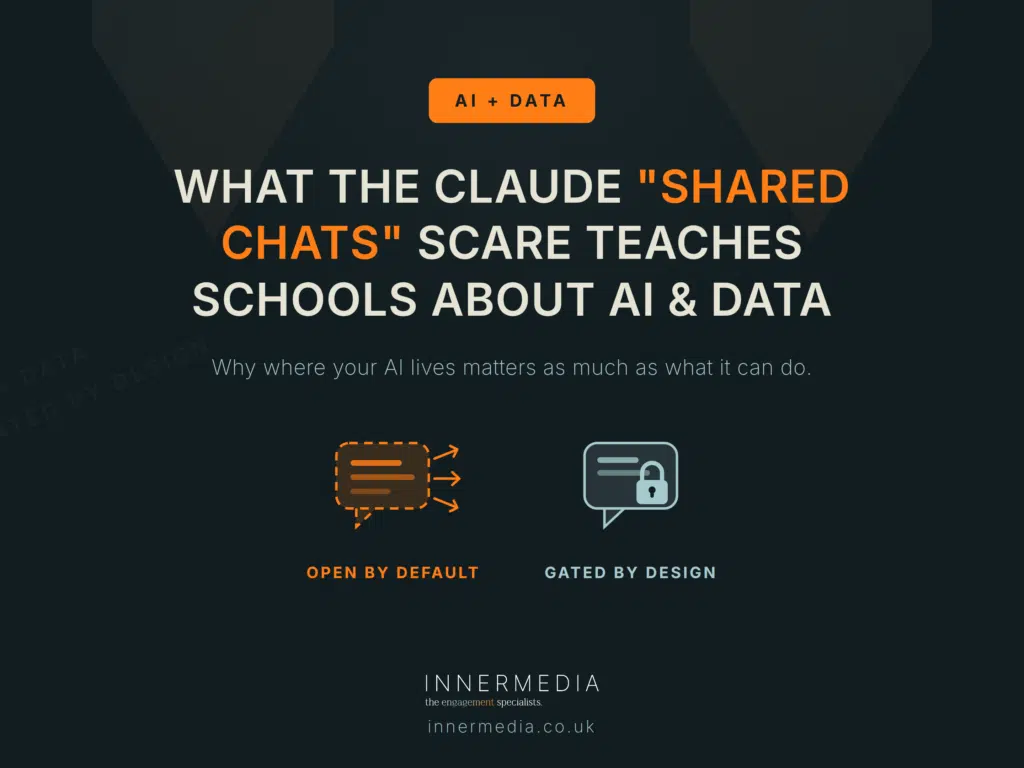
Open by default versus gated by design
This is the distinction we care about, and it is the reason we built amba the way we did rather than simply pointing schools at an off-the-shelf chatbot.
Free consumer AI tools are open by default. The conversation is theirs to store, the sharing model is public, and the person typing carries all of the responsibility for what should and should not go in. A gated system flips that around. amba is a closed, school-centric AI ecosystem that we build and manage around your school, not a public window onto the open web.
In practice, that means a few things that directly answer the risks the Claude story exposed:
- One controlled knowledge base. Every amba agent draws from a single, central source of truth that you and we curate. It answers from your approved content, rather than from whatever a staff member happens to paste into a public box.
- No public share links. amba works across your website, phone and in-page assistants inside a system we control. There is no consumer share button quietly turning conversations into crawlable pages.
- Built for GDPR and children’s data. amba is powered by Anthropic’s Claude through AWS Bedrock in UK and EU regions only. Data residency and compliance are designed in from the ground up, which for a school handling children’s data is not a nice-to-have.
- Your data stays yours. amba securely stores your school’s knowledge and learning, so insight builds over time inside your ecosystem, not out on someone else’s public platform.
None of this makes amba less capable. It is the same intelligent technology behind the tools everyone is talking about. The difference is that it sits inside a managed, gated environment built for the realities of school marketing and admissions, with the guardrails already in place.
What we would suggest doing this week
Whether or not you use amba yet, a few sensible steps protect your school right now:
- Ask your team what AI tools they are using day to day, and remind everyone that anything typed into a free public tool should be treated as potentially public.
- If staff have used share links in any consumer AI tool, review and delete the ones that are no longer needed.
- Keep prospective and existing parent data, pupil information and anything safeguarding-related out of open consumer tools entirely.
- Where AI genuinely helps, move it onto a system where compliance and data ownership are handled for you, rather than left to whoever is at the keyboard.
AI is going to keep making school teams faster and freeing them to spend more time on the families in front of them. That is a good thing, and we are all in on it. But the Claude story is a clear reminder that intelligent technology only helps when the human judgement around it is sound, and when the system it runs on was built to protect the people it serves. AI supports. Humans connect. The two work best behind a proper front door.
See what gated AI looks like for your school
amba is part of our aiSolutions suite and the imHUB ecosystem, built specifically for independent school marketing and admissions. We would be glad to walk you through it.