Two Google updates in six weeks: what March and May 2026 mean for your rankings
If your website traffic has felt unusually jumpy this spring, you are not imagining it. Google has now pushed two broad core updates in the space of six weeks, and the gap between them is the tightest we have seen in years.
What happened in March?
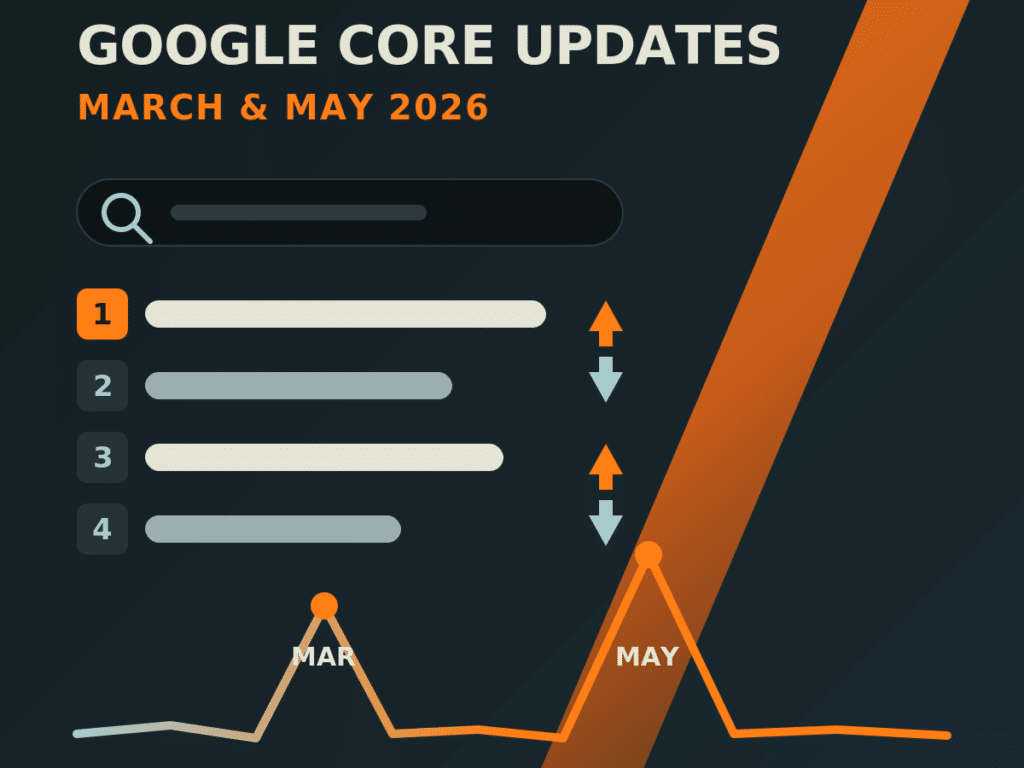
The March 2026 core update ran from 27 March to 8 April, overlapping with a separate spam update. By SE Ranking’s data it was the most volatile update on record: almost 80% of top-three results shifted position, and nearly one in four pages sitting in the top 10 dropped out of the top 100 altogether.
The pattern underneath the noise was clear. Google rewarded first-party, official and brand-owned destinations, and pulled visibility away from aggregators, directories and comparison sites. This was a shift away from the middleman and toward the original source. Job aggregators lost ground while employer career pages gained; broad consumer health sites slipped while clinical and specialist sources rose. Even YouTube took the single biggest visibility hit in the data. We touched on the early signals in our earlier post on Google’s updates; this piece picks up where that left off.
What May tells us
The May 2026 core update began rolling out on 21 May, just 43 days after March finished. For context, the shortest gap between distinct core updates in recent years was around 70 days. Google published no new guidance and used the same wording it always does, which strongly suggests May is reinforcing the same direction March set rather than changing course. On that pace, 2026 could see five to seven core updates rather than the usual two or three.
What these updates are targeting
Strip away the jargon and both updates are doing the same thing: rewarding the original source and demoting the in-between. Three signals stand out.
First, first-party authority. Google is favouring sites that are clearly the source of the information or service, rather than those that collect, repackage or compare what others have already published. If a page could have been written by anyone, it is increasingly vulnerable.
Second, genuine expertise and trust. Content that shows real experience, named authors, credentials and first-hand knowledge is holding up far better than thin, generic copy, particularly in areas like health and finance where trust matters most.
Third, the rise of AI answers. Pages that exist mainly to answer a quick factual question are losing ground because Google’s own AI summaries now handle those queries directly. Reference and dictionary-style content was hit hard for exactly this reason.
How to improve your rankings
We have noticed some keyword ranking drops since these updates landed, and that is to be expected. As with every Google update, the worst thing you can do is panic. The right response is to keep monitoring the numbers calmly, give them time to settle, and make improvements naturally rather than rushing into knee-jerk changes.
There is no quick fix, and Google has been explicit about that. A drop does not always mean something is broken. But the direction of travel gives a clear to-do list:
- Publish content only you could write. Lean on your own data, case studies, results and expertise rather than rehashing what is already out there.
- Show who is behind it. Add author names, bios and credentials, and make your experience and track record visible on the page.
- Be the destination, not the detour. Strengthen the pages that represent your core service or product so your site is the obvious primary source.
- Go beyond the obvious answer. If AI can answer a question in a sentence, add the depth, context and practical guidance it can’t.
- Build authority over time, not in a panic. With updates landing every few weeks, there is no time to react and recover between them. Consistent, quality-led work is what holds rankings steady.
That is exactly the work we do day to day: upfront metrics, transparent reporting, and no chasing algorithms for their own sake. If your rankings have moved and you would like a clear read on why, we would be glad to take a look.
Frequently asked questions
What is a Google core update?
A core update is a broad change to the way Google’s main search systems assess and rank content. Unlike a targeted fix, it reweighs how the whole index is judged, which is why rankings can move sharply across very different types of site at the same time.
Why were there two updates so close together?
The March update finished on 8 April and the May update began on 21 May, a gap of just 43 days. The usual gap in recent years has been 70 days or more. The cadence is clearly speeding up, and 2026 could see five to seven core updates rather than the usual two or three.
My rankings dropped. Does that mean my site is broken?
Not necessarily. Google has been clear that a drop after a core update does not always mean you have done something wrong. It often means other sites are now being judged as more relevant or authoritative for those searches. The fix is to keep improving the quality, expertise and originality of your content rather than hunting for a single error.
How long until I recover?
There is no instant recovery. Meaningful improvement usually shows up across future updates rather than overnight, so the work is to build genuine authority steadily rather than to react to each update.
Does AI in search change what I should do?
Yes, in emphasis. As Google answers more quick factual questions directly with AI summaries, the pages that win clicks are the ones offering depth, first-hand experience and practical value that a one-line answer cannot replace.
Should I keep publishing content?
Absolutely, provided it is content only you could produce, backed by real expertise and your own data or results. Thin, generic articles are the most exposed; original, genuinely useful content is what holds up.
Join the digital revolution…
By Sophie, Client Digital Strategist at Innermedia